
How to streamline your FBA prep centre process

Imagine your first major shipment heading to Amazon’s fulfilment centre, only to bounce straight back because labels were placed incorrectly or packaging didn’t meet specification. The stock sits in limbo, your listing goes out of stock, and competitors pick up your lost sales. It happens far more often than most new sellers expect, and the reason is almost always a preventable process failure. Missing or incorrect labels and wrong packaging are among the leading causes of FBA shipment delays, rework, and outright rejection for UK sellers. This guide walks you through every stage of a compliant, reliable FBA prep centre process so you can avoid those costly mistakes and keep your inventory moving.
Table of Contents
Key Takeaways
Point | Details |
Compliance is critical | Incorrect labels or packaging can result in immediate shipment rejection or costly delays. |
Preparation prevents errors | Clear coordination and providing all required documentation ensures your prep centre works efficiently and accurately. |
Reliability matters | Choose centres with proven communication, SLAs, and transparent reviews to avoid operational surprises. |
Systems drive scalability | Well-structured, audited processes reduce error rates and let you grow without bottlenecks. |
What is the Amazon FBA prep centre process?
A prep centre is a third-party warehouse that receives your products, checks them, applies the correct labels and packaging, and then sends them on to Amazon’s fulfilment network in a compliant, ready-to-scan condition. The concept sounds straightforward, but each step carries specific Amazon requirements that must be met precisely. Miss one, and the whole shipment can be held or sent back.
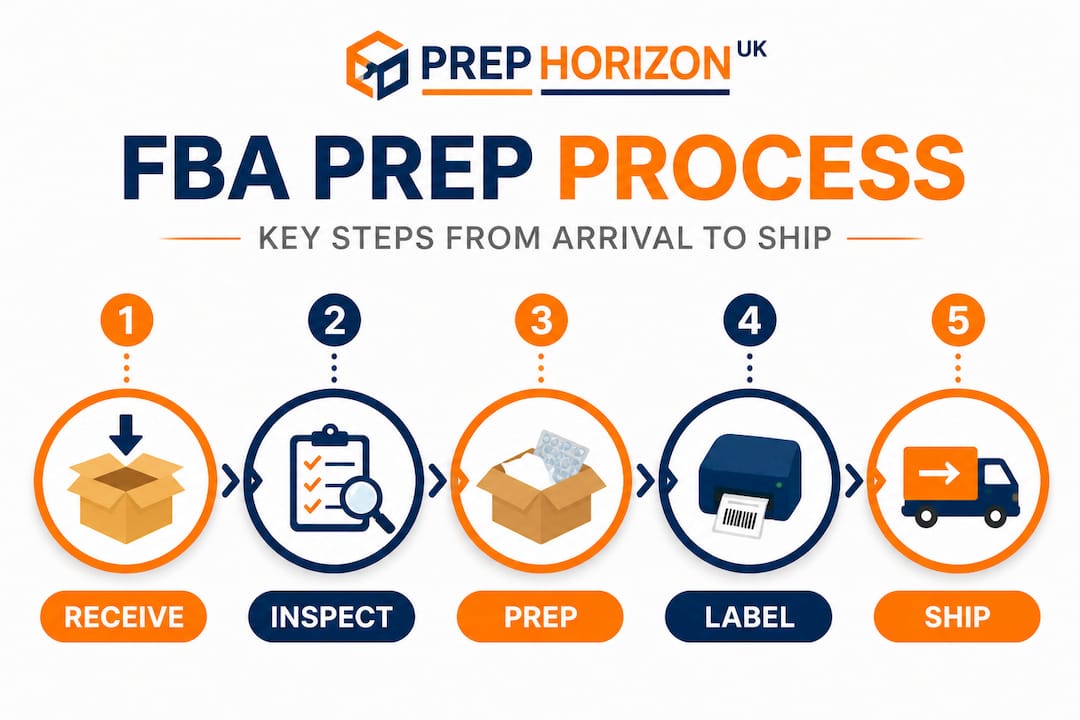
At its core, a well-run prep centre process covers the following stages:
Receiving: Your stock arrives at the prep centre and is booked in against your inbound shipment plan.
Inspection: Each unit is checked for damage, quantity discrepancies, and any obvious quality issues before processing begins.
Photo documentation: Good centres photograph your stock on arrival, giving you a clear record if disputes arise later.
Labelling: FNSKU barcodes, suffocation warning labels, and any category-specific labels are applied according to Amazon’s FBA prep requirements.
Packaging and bundling: Items are bagged, poly-wrapped, bubble-wrapped, or bundled as required by product type and Amazon’s rules.
Compliance checks: A final review ensures everything matches the shipment plan before booking is confirmed.
Despatch: The centre books the courier, creates the box-content information in Seller Central, and ships to the designated Amazon fulfilment centre.
The table below summarises the key stages and the consequences of skipping or mishandling each one:
Stage | What it involves | Risk if mishandled |
Receiving | Booking in, counting units | Inventory discrepancies |
Inspection | Damage and quantity check | Defective stock reaches Amazon |
Labelling | FNSKU, warnings, category labels | Shipment rejection or rework fees |
Packaging | Bagging, wrapping, bundling | Damage in transit, compliance failure |
Quality control | Final compliance check | Errors not caught before despatch |
Shipment creation | Box content, booking courier | Wrong fulfilment centre routing |
Sellers who underestimate the complexity of this chain often discover the hard way that UK shipping rules are detailed and unforgiving. A single incorrect label type, or a label applied over a manufacturer barcode, can trigger a rejection. The goal of understanding this process is to ensure nothing reaches Amazon unless it is genuinely ready.
Preparation steps: What you and your prep centre need
Understanding the components is one thing. Actually preparing before you send stock is quite another. There is a clear division of responsibility between what you as the seller must provide and what a reliable prep centre must deliver in return.
Here is what you need to supply before your shipment arrives:
A confirmed inbound shipment plan created in Seller Central, with the correct ASINs, quantities, and fulfilment centre assignments.
FNSKU details for each product. Your prep centre needs to know which barcode goes on which unit before stock arrives, not after.
Special handling instructions for fragile, oversized, or bundled products that fall outside standard prep.
Advance notification of arrival dates so the centre can allocate capacity and avoid processing backlogs.
Clear labelling preferences, including whether you want manufacturer barcodes covered, how bundles should be presented, and any retail packaging requirements.
On the other side of that equation, a trustworthy prep centre should provide a level of operational transparency that goes beyond just processing the physical items. You need to know what required FBA labels are being applied, when your stock was received, and whether any issues were flagged at inspection.
Reviews of prep centre services reveal a telling pattern. Positive experiences consistently highlight responsiveness, dashboard visibility, and faster processing, while negative experiences cluster around delays and ignored messages. Operational reliability and communication quality are what separate adequate providers from genuinely useful ones. That should guide your vetting process.
Pro Tip: Before committing to any prep centre, send a test shipment of 20 to 30 units. Review how quickly they confirm receipt, whether they provide photographic evidence, and how promptly they respond to queries. You will learn more from one test shipment than from any sales pitch.
When reviewing inventory preparation steps with your chosen centre, document every agreed process in writing. Verbal agreements are not useful when a shipment goes wrong and you need to establish what was agreed.

What you provide | What the prep centre provides |
Shipment plan and FNSKU details | Arrival confirmation and photo documentation |
Advance notice of delivery dates | QC inspection on receipt |
Special handling instructions | Compliant labelling and packaging |
Labelling preferences | Seller dashboard or status updates |
Product specifications | Escalation process for irregularities |
Step-by-step process: From arrival to Amazon shipment
With your prerequisites sorted, here is the actual FBA prep flow your products will experience once they arrive at the centre.
Arrival and initial booking: Stock is received, counted against your purchase order or shipment plan, and booked into the system. Any shortfalls or obvious outer carton damage are flagged immediately and photographed.
Unit-level inspection: Each item is inspected individually. This is not a cursory glance. A thorough centre checks for dents, leaks, manufacturer barcode readability, and any signs of transit damage that could lead to a customer return or Amazon rejection.
Label preparation: The correct barcode labelling requirements are confirmed against your shipment plan. FNSKU labels are printed to the correct size (typically 1 x 2 inches), in the correct font, with scannable contrast. Suffocation warning labels are prepared for poly-bagged items.
Packaging and bundling: Products are wrapped, bagged, or boxed according to Amazon’s category-specific rules. Glass items get extra protection. Multi-packs get “Sold as set” labels. Loose items going into poly bags get sealed properly.
Final quality control check: Before any unit is placed in a master carton, a final pass confirms that labels are applied correctly, packaging is intact, and unit counts match the plan. This is the last line of defence against labelling errors reaching Amazon.
Box content and shipment booking: Box content information is entered into Seller Central accurately. The courier booking is made, and carton labels are applied to the outer cases.
Despatch and tracking confirmation: The shipment leaves the centre with tracking details shared back to you promptly. You should be able to confirm the booking in Seller Central within hours, not days.
Here is a comparison of realistic versus unrealistic expectations around turnaround times:
Turnaround expectation | Realistic? | Context |
Same-day processing for all volumes | Rarely | Only feasible for small, pre-prepped consignments |
24 to 48 hours for standard prep | Often achievable | Common claim but verify with customer reviews |
3 to 5 days for complex bundling | Reasonable | Multi-SKU bundles or kitting take more time |
Guaranteed SLAs without caveats | Treat with caution | Independent audited benchmarks are rarely published |
Pro Tip: Ask your prep centre what their policy is when a unit arrives damaged or when there is a quantity discrepancy. A centre with a clear written escalation process is far safer than one that promises it will “never happen.”
Avoiding mistakes and maximising reliability
Knowing the workflow is only half the job. The other half is understanding where things break down and putting guardrails in place before they do.
The most common errors in FBA prep fall into three categories:
Labelling failures: Wrong label size, incorrect placement (over a vent or on a seam), labels applied to the wrong units, or FNSKU barcodes that will not scan.
Packaging failures: Items in poly bags without suffocation warnings, bundles that separate in transit, fragile items without adequate inner packaging, or products that fail Amazon’s drop-test standard.
Communication failures: Sellers not notified when stock arrives damaged, prep centres beginning work without full instructions, or units despatched before issues are resolved.
“Choose a prep centre the way you would choose a logistics partner, not a commodity supplier. The difference between a centre that flags a problem and one that quietly ships it through can be the difference between a clean account and a performance notice.”
Reliability is not built on promises. It is built on systems. Ask any prospective prep centre how they handle exceptions. Do they pause and contact you, or do they make judgement calls independently? Do they have a ticketing system or a way to track issue resolution? Barcode compliance alone has dozens of edge cases, from specific GS1 requirements to category exclusions, and you need a centre that treats those details seriously rather than processing at speed and hoping for the best.
Operational reliability consistently surfaces as the primary differentiator between prep centres that help sellers scale and those that create recurring headaches. Vet support quality as rigorously as you vet pricing.
Pro Tip: Request a sample of how your prep centre communicates issue resolution. Ask them to show you a real example of how they handled a problem for another seller. Willingness to share that detail is itself a strong indicator of operational maturity.
Why robust processes matter more than rock-bottom pricing
Here is the uncomfortable truth that most discussions about FBA prep avoid: the cheapest prep centre is almost never the most profitable choice for a growing seller.
When you are shipping 50 units a month, a difference of 20 pence per unit feels meaningful. Scale to 500 units per month, and a single shipment rejection or rework event will cost you far more than the cumulative savings from choosing the cheapest provider. One hold at the fulfilment centre can mean days of out-of-stock status during peak trading. That is not a theoretical risk. It is a pattern we see repeatedly with sellers who prioritised price and compromised on process quality.
The reality is that published SLA claims from prep centres are rarely independently audited. A centre advertising 24-hour turnaround may achieve that consistently, or may hit it only under favourable conditions. The only way to know is to look at verified customer accounts, not the provider’s own marketing copy.
What you are actually buying when you choose a prep centre is a system. You are buying the reliability of that system under different conditions: peak season volumes, supplier errors, last-minute shipment changes. A prep centre with a strong documented process, a clear communication framework, and a track record you can verify is worth paying more for. A reliable FBA prep requirements guide is only useful if your partner actually follows it consistently.
We have seen sellers switch to better-run centres, pay 15 to 20% more per unit, and reduce their overall cost base because they stopped losing inventory to rejections, reworks, and stock-outs. The numbers tell a clear story once you factor in the full cost of process failure, not just the line-item prep fee.
Systems and communication are what scale. Price is what attracts attention at the start. Do not let initial attraction become a long-term liability.
Partner with a trusted FBA prep centre for seamless operations
If this guide has made one thing clear, it is that the process matters as much as the price. Every step from arrival inspection to shipment creation carries compliance risk, and the prep centre you choose either manages that risk professionally or passes it back to you in the form of delays, rework, and lost revenue.

We built our service around exactly the pain points this article describes. At Prep Horizon UK, we offer fast, compliant, and transparent FBA prep for UK sellers, covering receiving, inspection, labelling, bundling, and shipment creation with clear communication at every stage. Whether you are scaling quickly or just getting started, our trusted FBA prep centre handles the complexity so you can focus on growth. Take a look at our affordable prep service pricing and find out how a well-run prep partnership can transform your Amazon operations.
Frequently asked questions
What are the biggest risks if my FBA prep centre makes mistakes?
Missing or incorrect labelling and non-compliant packaging are the most common causes of FBA shipment delays, rework costs, and outright rejection, all of which cost you time, money, and sales rank.
How fast should a quality UK FBA prep centre process my inventory?
Most centres quote 24 to 48 hour turnaround times, but these figures are not always independently verified, so always cross-reference stated SLAs with actual customer reviews before committing.
What communication standards should I expect from an FBA prep centre?
Responsive support and clear updates are non-negotiable; look for centres with a documented escalation process and regular status reporting, not just a promise to “be in touch if anything comes up.”
What paperwork does my prep centre need before they begin?
You should provide your inbound shipment plan, FNSKU barcode details for each product, and any special handling instructions before your stock arrives, so processing can begin without delays or assumptions.
Recommended
Comments