
Manage FBA inventory efficiently: a UK seller's guide

High storage fees and sudden restock limits have cost UK sellers thousands in lost sales. Poor inventory management is not just an inconvenience — it is a direct threat to your account health, your cash flow, and your ability to scale. Whether you are dealing with excess stock piling up in Amazon’s fulfilment centres or scrambling to replenish after an unexpected stockout, the consequences are real and expensive. This guide walks you through the core metrics, supply chain strategies, fee structures, and common pitfalls that every UK FBA seller needs to understand in 2026.
Table of Contents
Key Takeaways
Point | Details |
Keep IPI score high | Maintaining an IPI above 500 prevents costly storage limits and unlocks full FBA capacity. |
Forecast and replenish smartly | Use demand forecasting and keep 30-60 days of safety stock to avoid both stockouts and overstock fees. |
Act on aged inventory | Remove or liquidate items approaching surcharge age to minimise costs and maintain compliance. |
Hybrid solutions boost flexibility | Using 3PL or FBM buffers helps ease Amazon limits and protects against seasonal surcharges. |
Understanding Inventory Performance Index and FBA limits
With your motivation for avoiding costly mistakes established, let’s start with the core metric Amazon monitors: the Inventory Performance Index.
The Inventory Performance Index (IPI) is Amazon’s way of scoring how efficiently you manage your FBA inventory. Think of it as a report card that Amazon checks regularly to decide whether you deserve more shelf space in their fulfilment network. A low score means restricted storage capacity. A high score means more room to grow.
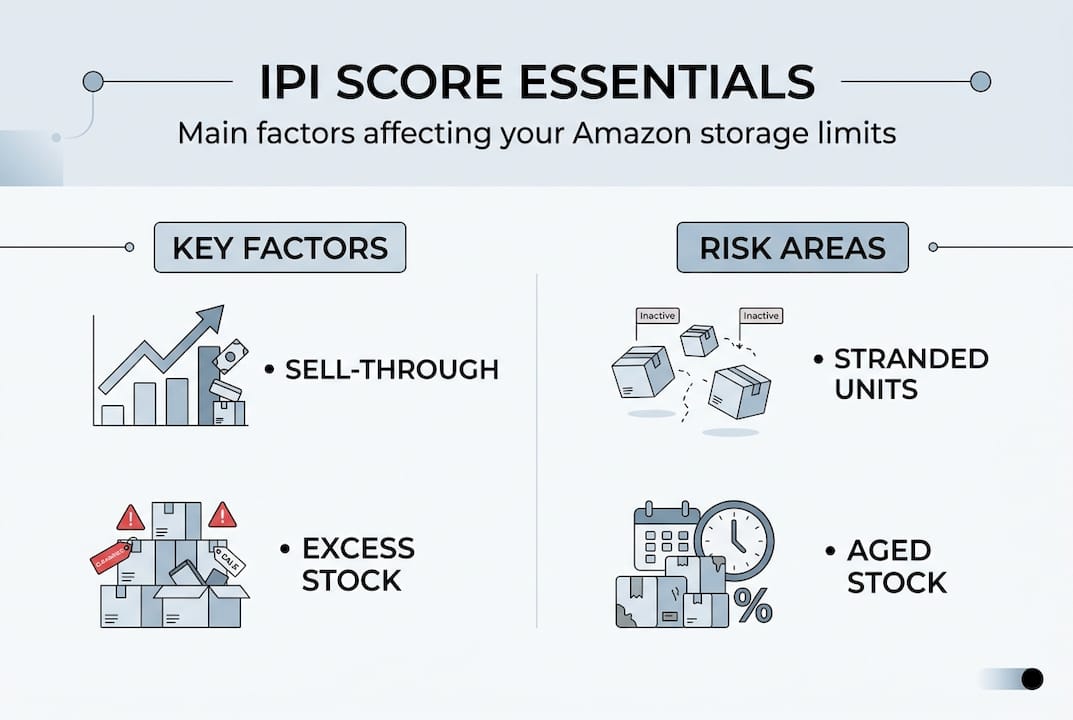
Your IPI is influenced by four key factors:
Excess inventory percentage: How much of your stock is unlikely to sell within 90 days
Sell-through rate: How quickly your inventory moves relative to what you have stored
Stranded inventory: Units that are in the warehouse but not listed for sale
Storage utilisation: How much of your allocated capacity you are actually using
Understanding IPI score factors is essential because each element feeds into your overall score. Neglecting even one can drag your number down significantly.
Here is how your IPI score translates into practical outcomes:
IPI score | Storage outcome | Fee risk |
Below 400 | Storage limits imposed | High surcharge risk |
400 to 449 | Restricted capacity | Moderate risk |
450 to 499 | Standard capacity | Low risk |
500 and above | Full capacity access | Minimal risk |
The minimum IPI threshold sits at 400, but experienced sellers aim for 500 or above to maintain full capacity access and avoid any restrictions. Falling below 400 triggers automatic storage limits, which can cripple your ability to send in new stock during peak trading periods.
To check your IPI score, log into Seller Central and navigate to Inventory, then Inventory Performance. You will see your current score, a breakdown of contributing factors, and your current capacity limits. Amazon updates this weekly, so it pays to check it regularly rather than waiting for a warning email.
For sellers who want to understand the full picture of FBA capacity management, it is worth noting that Amazon now uses a capacity-based system rather than a simple unit limit. Your capacity is measured in cubic feet and varies by product type. Getting your inventory preparation steps right from the start helps you avoid stranded inventory, which is one of the fastest ways to damage your IPI score.
Building your supply chain: forecasting, safety stock and replenishment
Once you understand your inventory metrics, the next step is structuring your supply chain to anticipate demand and respond quickly.
Sales velocity tracking is the foundation of everything. For each SKU, you need to know how many units you sell per day or per week on average. Most sellers use Seller Central reports, but dedicated tools give you more granular data and trend analysis. Demand forecasting tools like Sumtracker allow you to set reorder points automatically, factoring in supplier lead times and seasonal trends.

Safety stock is your buffer against the unexpected. Safety stock best practice recommends holding 30 to 60 days of supply at all times. That might sound conservative, but when a supplier misses a delivery or a product suddenly goes viral, that buffer is what keeps you in stock and selling.
Here is how to think about your replenishment numbers:
Supplier lead time | Forecast interval | Recommended safety stock |
7 to 14 days | 30 days | 15 to 20 days of supply |
15 to 30 days | 60 days | 30 days of supply |
31 to 60 days | 90 days | 45 to 60 days of supply |
To build a reliable replenishment plan, follow these steps:
Calculate your average daily sales velocity for each SKU over the past 30 and 90 days
Identify your supplier’s average lead time, including shipping and customs clearance
Set a reorder point: daily velocity multiplied by lead time, plus your safety stock buffer
Place orders automatically or set calendar reminders when stock drops to the reorder point
Review and adjust your plan monthly, accounting for upcoming promotions or seasonal shifts
Pro Tip: Schedule your replenishment orders before October to ensure stock arrives at Amazon’s fulfilment centres before the Q4 peak. Shipping coordination tips can help you manage the logistics of getting large volumes prepped and shipped on time. For sellers moving larger quantities, LTL shipping strategies can significantly reduce freight costs during high-volume replenishment periods.
Calculating FBA storage fees and avoiding costly surcharges
With replenishment plans in place, sellers must account for the financial aspect: FBA fees, surcharges, and how to optimise costs.
FBA storage fees in the UK follow a tiered structure that catches many sellers off guard. Standard monthly fees run from £0.56 to £0.76 per cubic foot between January and September. During the peak period from October to December, those fees jump by approximately 72%. That is a significant cost increase for sellers who have not planned their inventory levels carefully.
The real financial danger, however, is aged inventory. Items that have been in an Amazon fulfilment centre for 241 to 365 days attract additional surcharges. Stock sitting for over 365 days can cost up to £5.71 per cubic foot in aged inventory fees on top of the standard monthly rate.
FBA fees, including storage, fulfilment, and referral fees, can account for 30 to 50% of your total sale price when VAT is factored in. Understanding every component is not optional — it is essential for maintaining healthy margins.
Here is how to keep your storage costs under control:
Check your Inventory Age report in Seller Central at least once a month to identify items approaching the 241-day threshold
Run promotions or reduce prices on slow-moving stock before it enters the aged surcharge window
Use removal orders to pull stock back to your own storage or a third-party logistics (3PL) provider before fees escalate
Liquidate strategically using Amazon’s liquidation programme for items that are unlikely to sell at a profitable price
Review your UK FBA fee calculator to model the true cost of holding each product
Pro Tip: Set a calendar reminder to review inventory age every month. Acting before items reach 241 days gives you options. Waiting until they hit 365 days leaves you with a costly problem and far fewer solutions. For a detailed breakdown of inventory fee reduction tips, tools like Sumtracker can flag at-risk items automatically.
The aged inventory guidance is clear: items over 365 days should be removed or liquidated without exception. Holding on in hope of a sale rarely makes financial sense once surcharges are factored in.
Troubleshooting: common mistakes, edge cases and hybrid solutions
Even with robust plans and fee knowledge, sellers can stumble without awareness of common pitfalls and the flexibility of hybrid approaches.
The three most common inventory mistakes UK FBA sellers make are:
Ignoring IPI until it drops below 400: By the time Amazon restricts your storage, the damage is already done. Weekly monitoring is the only way to catch a declining score before it becomes a crisis.
Over-ordering based on optimistic forecasts: Buying too much stock ties up capital, inflates storage fees, and risks aged inventory surcharges. Base orders on data, not hope.
Neglecting stranded inventory: Units sitting in the warehouse without an active listing are invisible to buyers but very visible to your IPI score. A weekly stranded inventory check takes five minutes and protects your score.
For sellers facing capacity constraints or seasonal demand spikes, a hybrid approach is worth serious consideration. Here is how pure FBA compares to a hybrid model:
Approach | Advantages | Disadvantages |
Pure FBA | Prime badge, fast delivery, hands-off fulfilment | Capacity limits, high storage fees, less control |
Hybrid FBM/3PL | Buffer stock flexibility, lower storage costs, no capacity caps | Slower delivery, more logistics management required |
Edge case solutions that experienced sellers use include:
Holding buffer stock at a 3PL provider during periods of low IPI or Amazon capacity restrictions
Using removal orders proactively to cycle aged stock out of FBA before surcharges apply
Splitting shipments between FBA and FBM to maintain sales velocity during restock delays
The hybrid fulfilment approach is particularly effective for sellers who experience seasonal peaks requiring pre-October replenishment. Getting your inventory prepping strategies right before stock enters the fulfilment network reduces errors and keeps your IPI healthy. For time-sensitive shipments, fast prep techniques can make the difference between arriving before a peak and missing it entirely. For a full FBA fee breakdown to model your hybrid costs, the numbers often make a compelling case.
Pro Tip: Set a weekly IPI review in your calendar. When you spot stranded or aged stock, act within 48 hours. Speed matters because Amazon’s scoring is continuous, not quarterly.
What most guides get wrong about FBA inventory in the UK
Most inventory guides focus on volume. How much to order, how much to hold, how much is too much. That framing misses the point entirely.
The real driver of a healthy IPI score and sustainable profitability is sell-through rate, not volume. A seller moving 50 units a week efficiently will always outperform one holding 5,000 units that barely shift. UK sellers who fixate on having enough stock often end up paying for the privilege of holding stock that damages their metrics.
The other thing most guides overlook is UK-specific fee seasonality. The October to December peak surcharge is not a minor footnote — it is a potential margin-killer for sellers who have not planned their inventory levels carefully in September.
Hybrid approaches are consistently undervalued too. Holding buffer stock at a 3PL while keeping lean inventory at Amazon is not a workaround — it is a legitimate strategy that the most efficient sellers use deliberately. You can find UK FBA best practices and a detailed FBA labelling guide to support your operational setup. Weekly monitoring beats quarterly reviews every single time. The sellers who treat IPI as a live dashboard rather than a periodic check-in are the ones who avoid nasty surprises.
How Prep Horizon UK helps streamline your FBA inventory
If you want practical support for your inventory management and prepping needs, consider professional help that understands UK FBA nuances.
Managing IPI scores, storage fees, and replenishment timelines is demanding work. Getting the prep side wrong adds another layer of risk: mislabelled products, failed inspections, and delayed shipments all feed directly into your inventory performance metrics.

As a trusted FBA prep centre based in the UK, Prep Horizon UK handles receiving, inspection, labelling, bundling, and shipment creation so you can focus on sourcing and selling. Our services are built around the specific requirements of Amazon UK, including compliance with FBA packaging standards and efficient turnaround times that keep your supply chain moving. Explore our pricing and fee solutions to see how affordable professional prep can be for your business.
Frequently asked questions
What is a good IPI score for UK Amazon FBA sellers?
Aim for an IPI score above 500; scores below 400 trigger storage restrictions and increased fees that can seriously limit your ability to restock.
How can I prevent FBA stockouts and overstock?
Track sales weekly, forecast demand using historical data, and maintain 30 to 60 days of safety stock to balance availability against storage costs.
When do aged inventory surcharges apply and how much are they?
Aged inventory surcharges begin at 241 days and can reach up to £5.71/ft³ for items stored beyond 365 days in Amazon’s UK fulfilment centres.
What are the benefits of using hybrid FBA/FBM or 3PL for inventory management?
Hybrid fulfilment allows you to hold buffer stock during limits, reduce surcharge exposure, and maintain sales continuity during peak seasons when Amazon capacity is tight.
Recommended
Comments