
Estimate Amazon FBA costs: A complete UK seller guide

If you’ve ever launched a product on Amazon UK only to find your margin had vanished by the end of the month, you’re not alone. FBA fees are deceptively layered, and many sellers only account for the obvious ones — fulfilment and referral — while ignoring storage surcharges, returns processing, and the Digital Services Tax. This guide breaks down every fee you’ll face, explains exactly how to calculate them, and shows you how to build a budget that actually holds up when your first invoice arrives.
Table of Contents
Key Takeaways
Point | Details |
Know your fee categories | FBA costs include storage, fulfilment, referral, and surcharges—each must be carefully calculated. |
Use accurate measurements | Item size, weight, and storage duration impact your final costs and should be measured precisely. |
Beware of hidden charges | Returns, aged inventory, and category-specific surcharges can erode profit unexpectedly. |
Apply expert shortcuts | Optimise packaging, conduct frequent shipments, and use cost calculators for best results. |
Check with a trusted prep centre | A prep service like Prep Horizon UK can help streamline your FBA management and cut costs. |
Breakdown of main FBA fees every UK seller faces
Before you can estimate anything reliably, you need a clear picture of every fee category Amazon charges UK sellers. There are more than most people realise, and each one is calculated differently.
Fulfilment fees are the most visible. Amazon charges per unit shipped, based on the item’s size tier and weight. A standard small item (under 400g) currently sits around £2.70 per unit, while larger or heavier items scale significantly. The exact rate depends on which size bracket your product falls into, so always measure and weigh your items before listing.

Referral fees are a percentage of the total sale price including VAT. They typically sit between 8% and 15% depending on your product category, with a minimum charge of £0.25 per item. For most standard categories the rate is 15%, but once you add the Digital Services Tax (DST), the effective rate nudges to around 15.3%. Some apparel items sold at lower price points qualify for a reduced referral fee, which is worth checking if you sell clothing.
Monthly storage fees are charged per cubic foot of space your inventory occupies in Amazon’s fulfilment centres. Off-peak rates (January to September) run at approximately £0.75 to £0.78 per cubic foot, while peak rates (October to December) jump to £2.00 to £2.40 per cubic foot. That seasonal spike can blindside sellers who stock up heavily ahead of Q4 without planning their sell-through rate carefully.
Aged inventory surcharges kick in once stock has been sitting in an Amazon warehouse for more than 241 days. The penalties escalate sharply: £1.18 per cubic foot for items aged 241 to 270 days, rising all the way to £5.71 per cubic foot for anything held beyond 365 days. That’s on top of your regular monthly storage fee.
Here’s a quick summary of the core fee categories:
Fee type | Basis | Approximate rate |
Fulfilment fee | Per unit, by size and weight | £2.70+ per unit |
Referral fee | % of sale price inc. VAT | 8% to 15% (min £0.25) |
Monthly storage | Per cubic foot | £0.75 to £2.40/ft³ |
Aged inventory surcharge | Per cubic foot, 241+ days | £1.18 to £5.71/ft³ |
Returns processing | Per unit returned | Varies by category |
Understanding efficient FBA inventory management is the single best way to keep storage and aged inventory fees under control. And if you’re still getting to grips with the full landscape, familiarising yourself with the different seller services for UK FBA will help you identify where professional support can reduce your costs.
Essential data and tools needed to estimate your FBA costs
Knowing what fees exist is one thing. Having the right data to plug into your calculations is another matter entirely. Sellers who estimate costs accurately are those who gather specific, precise inputs before they run any numbers.
Here’s what you need to collect for every product:
Dimensions and weight: Measure your item in its final packaged state, not bare product. Amazon calculates fees based on the unit ready for fulfilment.
Selling price: This must include VAT for referral fee calculations.
Expected storage duration: How many days will inventory sit in the warehouse before selling? Be honest. Optimistic sell-through assumptions are one of the biggest causes of unexpected fees.
Ex-factory cost, freight, duty, and VAT: These make up your landed cost before Amazon fees even enter the picture.
Prep costs: Labelling, bundling, bagging, and any other handling fees.
The true landed cost formula works like this: ex-factory cost + freight + duty + VAT + prep cost per unit + Amazon fees (referral + FBA fulfilment + storage + optional fees). Every element must be accounted for, or your margin calculation is fiction.
For tools, Amazon’s own Revenue Calculator is a reasonable starting point, but it doesn’t factor in storage duration or surcharges. A well-structured spreadsheet that maps each fee individually gives you far more control. Many UK sellers also use third-party tools like Helium 10 or Sellerboard, which pull live fee data and apply it to your product catalogue automatically.
Tool | Best for | Cost |
Amazon Revenue Calculator | Quick single-product estimates | Free |
Sellerboard | Ongoing profit tracking with live fees | Paid |
Custom spreadsheet | Full control over custom scenarios | Free (your time) |
Helium 10 | Research and fee benchmarking | Paid |
New sellers should benchmark against industry figures: startup costs for FBA typically range from £2,500 to £5,000, and Amazon fees increased by 4% to 7% in 2024 alone. If you’re not revisiting your estimates regularly, you’re likely working from outdated numbers.
Pro Tip: When estimating prep costs, work with a dedicated prep centre to get fixed per-unit pricing. Variable or unknown prep costs are a common blind spot that throws off otherwise solid budgets. Reviewing FBA prep cost-saving tips can help you identify where you’re overspending before you scale.
Knowing how to prepare inventory for Amazon FBA correctly also prevents costly rework fees and delays that eat into your planned margins.
Step-by-step: Calculating your total FBA costs
Now you have your data and your tools. Here’s how to put them together in a logical sequence that gives you an accurate per-unit cost and an overall margin figure.
Step 1: Establish your landed cost per unit. Add together your ex-factory price, freight per unit, import duty, VAT on the landed value, and your prep cost. This is your baseline before Amazon takes anything.
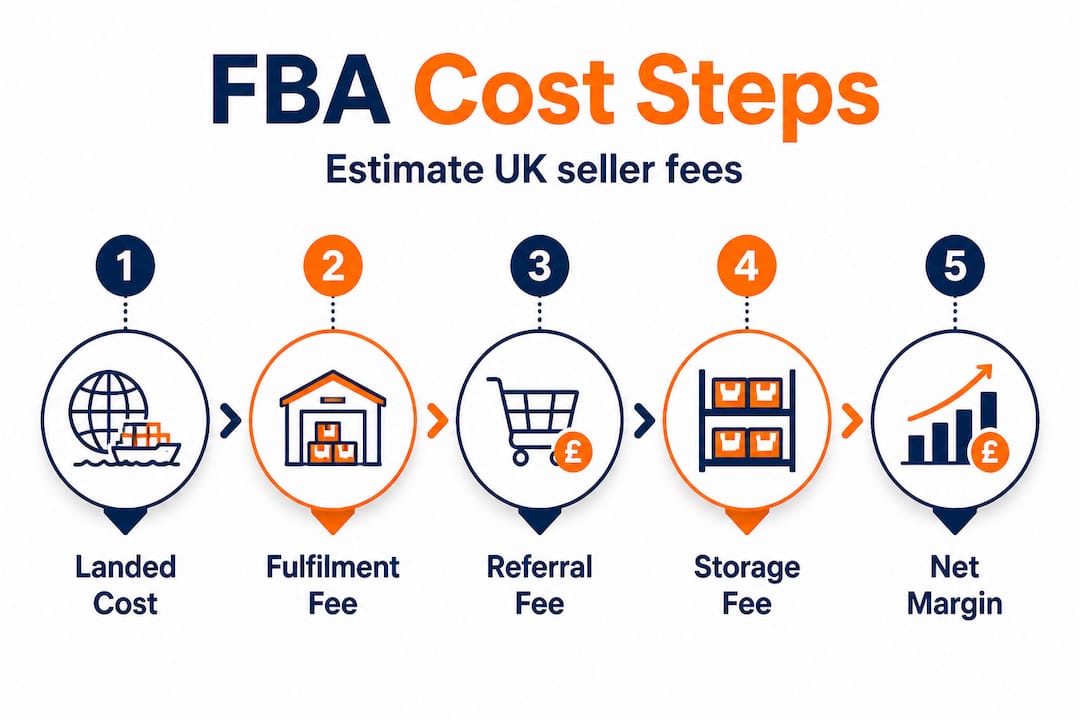
Step 2: Calculate your fulfilment fee. Use Amazon’s size tier chart and your packaged weight to find the applicable per-unit fee. Double check the category, as some product types carry higher base rates.
Step 3: Calculate your referral fee. Multiply your sale price (including VAT) by the applicable referral percentage. Add the DST component if relevant to your category.
Step 4: Estimate monthly storage fees. Calculate your product’s cubic footage (length × width × height in inches, divided by 1,728 for cubic feet). Multiply by the monthly rate and your expected storage duration in months. Weight seasonal rates appropriately if you’re carrying inventory through October to December.
Step 5: Factor in aged inventory risk. If any portion of your stock is likely to sit beyond 180 days, apply a weighted surcharge to that portion.
Step 6: Add optional and variable fees. Returns processing, hazmat surcharges, or oversized item fees where relevant.
Step 7: Subtract total fees from your sale price to get your net margin.
Here’s an example with real numbers:
Cost element | Amount |
Sale price (inc. VAT) | £25.00 |
Landed cost per unit | £6.50 |
Fulfilment fee | £3.20 |
Referral fee (15.3%) | £3.83 |
Storage (monthly, 2 months) | £0.40 |
Total costs | £13.93 |
Net margin | £11.07 (~33%) |
This aligns with the average net margin of around 33% for a £25 item after all fees, though Amazon’s total take across fees can reach 30% to 50% of your selling price depending on the category and how long your stock sits.
Pro Tip: Run your margin calculation at three storage scenarios: 30 days, 90 days, and 180 days. This tells you exactly when your product becomes unprofitable if sales slow, and it forces you to set clear reorder and removal triggers before you’re in trouble.
Reading up on ways to boost FBA profits and understanding how fast FBA shipping affects your inventory velocity can both directly improve the margin figures you’re targeting.
Common surcharges, edge cases, and hidden fees
Most guides stop at the main fee categories. The fees below are the ones that actually wreck margins for sellers who haven’t planned for them.
Aged inventory surcharges beyond 181 days are frequently underestimated. Even the 181 to 240 day bracket triggers monitoring and the clock ticks fast on slow-moving stock.
Storage utilisation surcharges apply when your share of Amazon’s warehouse capacity is high relative to your sales velocity. This is particularly punishing for sellers who send large quantities of slow-moving inventory.
Returns processing fees now apply to high-return product categories. Apparel, for example, attracts a 50% fulfilment fee applied to returned units. If your product has a return rate above Amazon’s threshold for its category, you’ll be charged automatically.
Hazardous goods and dangerous goods (DG/hazmat) incur a surcharge of approximately £0.10 per unit on top of standard fees. This applies to items with batteries, certain chemicals, aerosols, and more.
Oversized and pan-EU surcharges catch sellers who ship bulky items or who unknowingly enrol in cross-border programmes without accounting for the additional per-unit cost.
“Understanding which of your products fall into edge-case fee categories before you list them is the difference between a profitable product and one that silently drains cash month after month.”
Mitigation strategies worth implementing:
Send smaller, more frequent shipments to reduce the volume of aged inventory at risk
Review and optimise your packaging dimensions to drop into a lower size tier
Set automated removal orders for inventory approaching the 180-day mark
Use Amazon’s Low-Price FBA option for items priced under £10, which carries reduced fulfilment fees
Always check whether your product qualifies as hazmat before listing, and factor in the surcharge accordingly
Understanding FBA shipping compliance rules is essential here, particularly when dealing with restricted categories or specialised packaging requirements. If you’re using freight forwarding, solid LTL shipping practices for FBA also help you manage shipment sizes without inflating storage risk.
Why most FBA cost guides miss the real pitfalls
Most FBA cost guides present the fee schedule, show you a calculator, and leave you to it. That’s genuinely not enough. The sellers we see running into trouble aren’t those who missed the referral fee percentage. They’re the ones who built their numbers on best-case assumptions and never stress-tested them.
The first blind spot is aged inventory. It’s easy to read the surcharge table and assume it won’t apply to you because your product will sell. But seasonality, a failed PPC campaign, a ranking drop, or a supplier delay can all leave stock sitting far longer than planned. The strategies to avoid aged stock are straightforward: frequent small shipments, packaging optimisation to hit a lower size tier, and monitoring your utilisation rate. The issue is that most sellers only start doing these things after they’ve been burned.
The second blind spot is the Digital Services Tax. Many guides mention referral fees without adding the DST component. For sellers in standard categories, that 0.3% gap between the headline referral rate and the effective rate sounds trivial. At volume, it’s not.
The third is returns. Returns processing feels like an edge case until you’re selling apparel or electronics and your return rate hits the threshold. At that point, it’s a fixed cost you should have been modelling from day one.
Our honest take: profitability in FBA is not about finding the lowest headline fee. It’s about knowing every single cost source and building a model that accounts for variance. Read across our FBA seller blog for real-world scenarios we encounter with UK sellers regularly, because the gap between a spreadsheet estimate and real-world costs is always in the details.
Streamline your FBA cost management with Prep Horizon UK
Knowing your fees is only half the equation. Controlling the costs you can actually influence is where the real gains come from, and prep is one of the most impactful levers available to UK sellers.

At Prep Horizon UK, we work directly with Amazon sellers to take the preparation side of FBA off your plate. Accurate labelling, correct bundling, compliant packaging, and clean shipment creation all reduce the risk of Amazon rejecting your inventory or charging rework fees. Our pricing is transparent and per-unit, so you can factor it precisely into your landed cost formula without surprises. Whether you’re just starting out or scaling an established catalogue, explore our cost-saving prep ideas to see where working with a specialist prep centre can improve your margins from day one.
Frequently asked questions
How do I estimate Amazon FBA storage fees in the UK?
Multiply your product’s volume in cubic feet by the monthly rate, using £0.75 to £0.78 per cubic foot off-peak (January to September) and £2.00 to £2.40 per cubic foot during peak months (October to December), then add any aged inventory surcharges if stock will sit beyond 241 days.
What percentage does Amazon take from my sale price?
Amazon’s total fees range from 30% to 50% of the selling price once referral, fulfilment, storage, and other applicable fees are combined, with the exact figure depending heavily on your product category and inventory turnover rate.
Are there extra FBA fees for returns and special categories?
Yes, high-return category surcharges apply automatically once your return rate exceeds the category threshold, with apparel incurring a 50% fulfilment fee on returned units, and hazardous or oversized goods carrying additional per-unit charges.
What is the landed cost formula for Amazon FBA?
Landed cost per unit equals your ex-factory cost plus freight, import duty, VAT, and prep costs, with all Amazon fees (referral, fulfilment, storage, and optional surcharges) added on top to give you your true total cost before calculating margin.
Recommended
Comments