
Handle Amazon FBA returns: a UK seller's complete guide

Returns are a fact of life for any Amazon FBA seller, but mishandling them is where real money gets lost. Whether you’re seeing a spike in unsellable inventory, missing out on reimbursements you’re legally entitled to, or watching your seller metrics slip, a poorly managed returns process can quietly erode margins that took months to build. This guide walks you through exactly how Amazon handles UK FBA returns, what you can do to prevent unnecessary ones, how to claim what you’re owed, and how to deal with edge cases that catch even experienced sellers off guard.
Table of Contents
Key Takeaways
Point | Details |
Automated returns processing | Amazon FBA handles returns for UK sellers, reducing manual workload and streamlining inventory decisions. |
Proactive return reduction | Optimising listings and product prep can significantly lower return rates and boost profits. |
Timely reimbursements matter | File claims and monitor reimbursements promptly to avoid lost revenue from returns and damaged items. |
Data-driven auditing | Use analytical tools like pivot tables to find and fix costly return patterns in your inventory. |
Professional support boosts efficiency | Specialist FBA prep services help manage returns and maintain optimal inventory health for UK sellers. |
Understanding Amazon FBA returns in the UK
When a customer returns a product fulfilled through FBA, Amazon takes care of the physical side of things at the fulfilment centre. You don’t have to arrange collection or inspect items yourself. However, understanding what happens behind the scenes is critical, because the outcome of that inspection directly affects your inventory and your bottom line.
Amazon handles FBA returns automatically for UK sellers, inspecting items at fulfilment centres and classifying them as sellable or unsellable. This classification is the key decision point. A sellable item goes straight back into your active inventory and can be purchased by the next customer. An unsellable item sits in a separate category and begins costing you storage fees without generating revenue.
The classification outcomes break down into several grades:
Sellable: Item is undamaged, original packaging intact, suitable for resale
Customer damaged: Returned by the customer in a state that prevents resale
Carrier damaged: Damaged in transit, not the customer’s fault
Defective: Item has a fault, Amazon flagged it during inspection
Warehouse damaged: Damaged while in Amazon’s fulfilment centre
Once an item is classed as unsellable, you have a limited set of options. You can request a removal order to have the item sent back to you or a third-party address, you can arrange liquidation through Amazon’s programme, or in some cases you can submit a disposal order. Understanding the types of Amazon seller services available to you makes it easier to plan which route suits your product type and margin structure.
Important: Storage fees still accrue on unsellable inventory. Leaving items in an unsellable state for months is one of the most common ways UK sellers quietly bleed money without realising it.
Here’s a quick comparison of your main options for unsellable FBA inventory:
Option | Cost | Speed | Best for |
Removal order | Per-unit fee | 14 to 28 days | Repairable or resellable items |
Liquidation | Sold at low percentage | 60 to 90 days | Bulk clearance |
Disposal | Per-unit fee | 14 to 28 days | Damaged goods with no resale value |
Reimbursement claim | Free to file | Varies | Items lost/damaged by Amazon |
Understanding FBA inventory efficiency means knowing which of these options to use and when, rather than defaulting to the same approach for every return.
Preventing unnecessary returns: proactive UK strategies
Prevention is always more efficient than recovery. The good news is that a significant proportion of returns are preventable, and most trace back to a handful of avoidable issues: inaccurate listings, inadequate packaging, or poor-quality product images that create mismatched expectations.
To minimise returns proactively, focus on accurate descriptions, high-quality images, detailed size charts, quality packaging and prep, and monitoring return reasons by ASIN on a monthly basis. These aren’t aspirational ideas; they’re specific levers that directly reduce return rates when acted upon consistently.
Here’s what proactive return prevention looks like in practice:
Listing accuracy: Use precise measurements, material descriptions, and compatibility information. Vague listings invite returns from customers who made assumptions.
High-quality imagery: Show the product from multiple angles, include lifestyle images, and use infographics to illustrate dimensions or features.
Size and fit charts: Especially important in apparel, footwear, and items with variable sizing. A missing size chart is practically an invitation for a return.
Packaging integrity: Products that arrive damaged generate returns regardless of product quality. Following the correct inventory preparation tips reduces damage-in-transit rates noticeably.
ASIN-level monitoring: Review your return reason reports in Seller Central regularly. Set alerts for any ASIN where returns spike above your baseline.
FBA shipping strategies also play a role here. Items that arrive at fulfilment centres already damaged or incorrectly labelled create downstream problems that eventually show up as return classifications. Getting labelling right from the start removes one of the most common sources of preventable damage and misidentification.
Pro Tip: Run a monthly return analysis by pulling your “Returns Report” from Seller Central and filtering by return reason code. If a single reason accounts for more than 30% of returns for a given ASIN, that’s your signal to investigate that specific product or listing immediately. Small fixes at this stage can have a disproportionate impact on return volume.
Navigating refunds, reimbursements and partial returns
Even with excellent prevention, returns will happen. The question is whether you’re capturing all the money you’re owed when they do. Many UK sellers underestimate the financial impact of unclaimed reimbursements and unmanaged partial refund options.

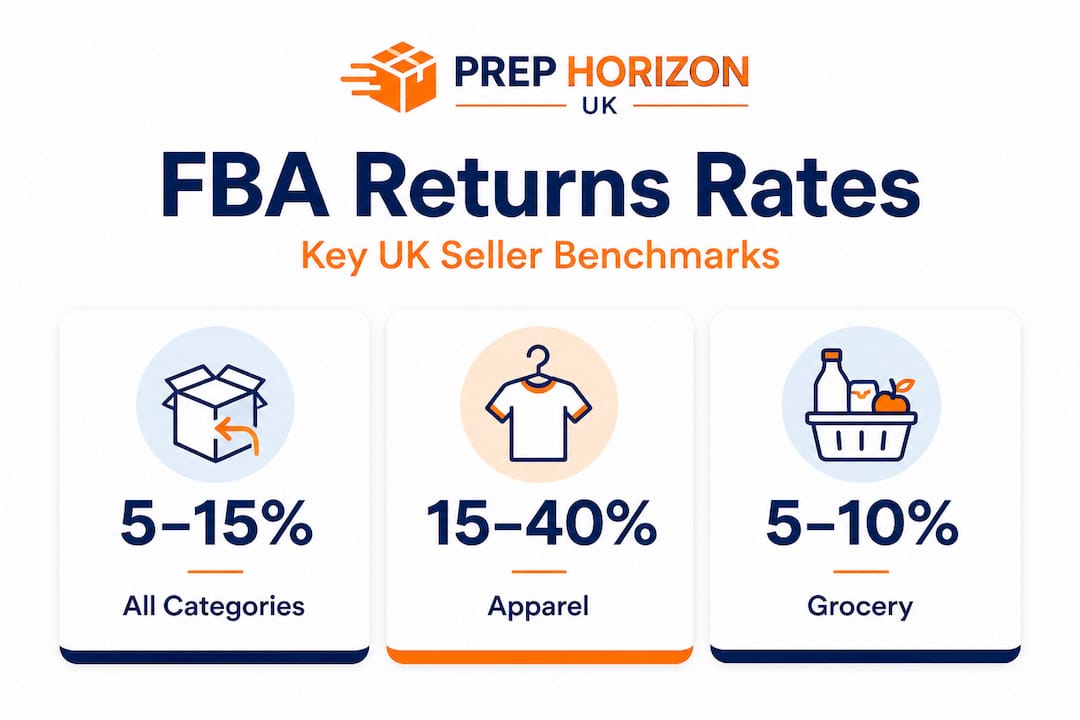
UK FBA sellers can lose 1 to 3% of annual revenue if reimbursements go unclaimed, with average return rates sitting between 5 and 15% across categories, rising to 15 to 40% in apparel and electronics, and dropping lower in grocery. At scale, even a 1% revenue leakage on unclaimed reimbursements represents thousands of pounds annually.
Reimbursements are available for lost or damaged items while under Amazon’s control, for customer refunds issued without items being returned, and for inbound shipment discrepancies. Claims must be filed via Seller Support with supporting documentation, typically within 18 months for most UK cases. Missing this window means forfeiting your entitlement entirely.
Here’s a step-by-step process for filing a reimbursement claim:
Open Seller Central and navigate to “Payments” then “Transaction View”
Cross-reference your inventory reports against fulfilment centre records to identify discrepancies
Pull the relevant order ID or shipment ID for the item in question
Go to “Help” in Seller Central and open a case with Seller Support
Submit documentation including the order ID, product details, estimated value, and any shipping records
Follow up if no response arrives within 7 business days; Amazon’s SLA is not always met
Record each claim in a separate tracking spreadsheet so you can monitor resolution and escalate if needed
Partial refunds are also available in the UK without a physical return for eligible products. This option is configurable in FBA settings and is particularly useful for low-value items where the handling and return shipping costs exceed the product value. Offering a partial refund rather than a full return can reduce operational friction and improve customer satisfaction simultaneously.
These financial decisions are part of a broader approach to boosting FBA profits that goes beyond just selling more units. Managing what you keep from every sale matters just as much as acquiring more sales.
Category | Average return rate | High-end return rate |
Apparel and fashion | 15 to 25% | Up to 40% |
Electronics | 10 to 20% | Up to 35% |
Grocery and food | 1 to 3% | Under 5% |
Home and kitchen | 5 to 10% | Up to 15% |
Books | 2 to 5% | Under 8% |
Handling edge cases and common return pitfalls
The standard returns process runs smoothly most of the time. But edge cases are where sellers lose patience and, more importantly, money. Knowing what to expect from these situations prevents costly mistakes and unnecessary frustration.
Some reimbursements require waiting up to 105 days before a claim can be filed. Items damaged in the warehouse or by a carrier cannot be removed from inventory in the usual way. International returns follow different protocols and timelines. ASINs with return rates above 10 to 15% need an urgent audit rather than a routine check.
Here’s a numbered troubleshooting process for common edge cases:
Delayed reimbursement: Wait the full 105-day window before escalating. Document the original shipment date and raise a case referencing your Fulfilment by Amazon service agreement.
Warehouse-damaged inventory: Check your Inventory Adjustment Report in Seller Central. Items marked as damaged by Amazon should trigger an automatic reimbursement; if not, raise a case with the ASIN and fulfilment centre ID.
Carrier damage claims: These require working with both Amazon and the carrier. Keep your proof of delivery and inbound shipment records.
International return discrepancies: If you’re selling across European marketplaces through pan-European FBA, returns may be processed at fulfilment centres in different countries. Reconcile per-marketplace.
High return rate ASINs: Pull the ASIN-level returns report, identify the top return reasons, and schedule a product review before investing further in PPC or inventory replenishment.
Roughly 80% of returns often come from 20% of SKUs or return reasons. Using pivot tables on your returns report to isolate which SKUs or reasons account for the largest volume is one of the most effective analytical shortcuts available. If a single return reason accounts for over 40% of returns on a specific ASIN, that’s a root cause worth investigating immediately, whether it points to a listing issue, a product quality problem, or a packaging failure.
Pro Tip: Use Excel or Google Sheets to build a pivot table from your returns data each month. Group by ASIN and return reason to quickly surface which combinations are driving the bulk of your return volume. This takes about 20 minutes and consistently reveals patterns that would take hours to spot manually.
Key patterns to watch for in your edge case audits:
Sudden spike in “not as described” returns following a listing change
Carrier damage returns increasing after switching inbound shipping routes
Unsellable rate rising during peak periods due to rushed fulfilment centre handling
Repeat returns from a specific product variant (size, colour) rather than the whole ASIN
A seasoned seller’s perspective: what works in real-world FBA returns
Here’s something most guides won’t tell you: the sellers who manage returns best aren’t the ones who respond fastest when things go wrong. They’re the ones who’ve built systems that make returns predictable and manageable before problems escalate.
The honest truth is that most return spikes are signals, not crises. A sudden jump in returns on a single ASIN is almost always telling you something specific: a listing that no longer matches the product, a packaging change that’s causing transit damage, or a supplier batch with quality inconsistencies. The instinct to treat returns as a customer behaviour problem leads sellers to try tactics like better customer communication or revised return policies. Those rarely move the needle. The real answer almost always lives in your data.
What actually works is integrating your return rate into your unit economics from the beginning. If your ACoS calculation doesn’t account for a realistic return rate by category, your profitability numbers are optimistic fiction. Build in a return cost at the product research stage and you’ll make smarter inventory and advertising decisions from day one. This connects directly to expert seller perspectives on sustainable FBA margins.
The other underrated insight is that professional prep genuinely reduces returns. Products that arrive correctly packaged, accurately labelled, and within FBA compliance guidelines have lower damage rates, fewer fulfilment errors, and ultimately generate fewer returns. Sellers who try to cut corners on prep to save a few pence per unit often end up paying far more in return-related costs. The maths rarely favours the shortcut.
Following the correct FBA shipping rules isn’t just about avoiding penalties. It’s one of the most underappreciated return prevention tools available to you.
Streamline Amazon FBA returns with professional support
Managing returns well starts long before a customer clicks the return button. The quality of your prep, the accuracy of your labelling, and the compliance of your shipments all influence how your products perform post-sale.

As a trusted FBA prep centre built specifically for UK sellers, we handle receiving, inspection, labelling, bundling, and shipment creation with the kind of accuracy that reduces downstream errors. Fewer prep mistakes mean fewer avoidable returns, faster reimbursement processes, and cleaner inventory records. When you’re ready to scale without the stress of managing every detail yourself, our affordable FBA prep services are designed to fit your operation. Get in touch to find out how we support sellers at every stage of the FBA journey.
Frequently asked questions
How are FBA returns processed for UK sellers?
Amazon inspects returned products at fulfilment centres and classifies them as sellable or unsellable before sellers take any action. Sellable items re-enter your active inventory automatically.
Can I get reimbursed for lost or damaged FBA items in the UK?
Yes. Claims can be filed via Seller Support with documentation for items lost or damaged under Amazon’s control, typically within 18 months of the incident.
What is the typical FBA return rate for UK sellers?
Return rates average 5 to 15% across most categories, rising to 15 to 40% in apparel and electronics, with grocery sitting significantly lower.
Are partial refunds possible on UK FBA returns?
Yes. Partial refunds can be issued without a physical return for eligible products and can be configured directly in your FBA settings to reduce handling costs.
How can I reduce my Amazon FBA return rate?
Monitor return reasons monthly, optimise your listings with accurate descriptions and images, and ensure your packaging and prep meet FBA standards consistently.
Recommended
Comments