
Get FBA packaging right for UK Amazon compliance

A well-packed product is not the same as an FBA-ready product. That distinction catches out thousands of UK sellers every year. You could bubble-wrap your items perfectly, seal every box with care, and still face delays or outright rejections at Amazon’s fulfilment centres because a stray barcode is visible on the side of the carton, or a polybag is missing a legally required suffocation warning. Amazon’s FBA packaging rules go well beyond physical protection. They cover barcode management, bag specifications, carton dimensions, weight limits, and category-specific requirements. This guide covers everything UK FBA sellers need to know in 2026, including where prep centres can make the difference.
Table of Contents
Key Takeaways
Point | Details |
Barcode clarity | All extra, non-FBA barcodes must be covered or removed to ensure only the correct barcode is scannable. |
Polybag warning rules | Suffocation warnings are required on bags 5 inches or more across at the opening, measured flat. |
Category-driven packaging | Product and packaging requirements vary by type—apparel, liquids, and adult items need unique prep. |
Box size and weight limits | All FBA cartons must stay within very specific size and weight thresholds to be processed quickly. |
Advanced options | SIPP may let you reduce repackaging, but it requires strict qualification and product testing. |
What are Amazon FBA packaging requirements in the UK?
Amazon’s FBA packaging requirements are not optional guidance. They are enforced at intake, and non-compliant shipments are held, returned, or disposed of. Before your products even reach a shelf at an Amazon fulfilment centre, they pass through a receiving process that checks packaging against a defined set of criteria.
The core requirements cover several distinct areas. First, every individual unit must carry a scannable, Amazon-acceptable barcode. Second, the outer packaging must match the product category’s required prep type. Third, the carton carrying the units must meet size and weight standards. Each layer of compliance matters independently.
Amazon distinguishes between product categories when it comes to packaging. As noted in Amazon Seller Forums discussions, specific packaging types are required depending on the product: liquids and powders must be poly-bagged; small items under a certain size threshold need transparent polybags; textiles need poly bagging or shrink-wrap; adult items require opaque bags. This is not a case where one approach fits every product.
Here is a quick comparison of common product categories and their required prep:
Product category | Required prep type | Special considerations |
Liquids and powders | Sealed polybag | Must be leak-proof and secure |
Textiles and clothing | Polybag or shrink-wrap | Suffocation warning often required |
Small items (below threshold) | Transparent polybag | Must remain scannable through bag |
Adult items | Opaque polybag | No see-through packaging permitted |
Fragile glass/ceramics | Bubble wrap or foam | “Fragile” label may be required |
Sets and bundles | Secure outer packaging | “Sold as set” label required |
Remember: Amazon’s packaging requirements are not static. Category rules can change, so keeping your prep process updated is essential. Relying on last year’s checklist is a risk.
The practical takeaway when preparing inventory for FBA is that you must know exactly which category each product falls into before a single item is prepped. Getting this wrong upstream creates expensive problems downstream.
Barcode and labelling rules: avoiding costly scanning errors
Once the packaging type is sorted, next comes barcode control, which is where most costly compliance errors begin.
Every FBA unit must have a single, clearly visible, scannable barcode. This sounds simple. In practice, it is one of the most frequently mismanaged steps in the entire prep process. The issue is not always a missing barcode. Often, it is the presence of too many.
When manufacturers ship products in bulk cartons, those outer cartons almost always carry their own barcodes. A GS1 barcode, a freight barcode, or an FNSKU from a previous shipment. Any of these, if left visible on the outer box, can interfere with Amazon’s receiving scanners. Amazon Seller Forums guidance is clear: each unit must have an accessible, scannable barcode, and any existing external barcodes on shipping boxes should be covered or rendered unscannable to prevent processing errors.
Here is a step-by-step approach to barcode compliance that reduces errors significantly:
Identify all existing barcodes on the outer carton before prepping. Look at all six sides of the box.
Cover or black out any manufacturer or transit barcodes using opaque labels or black tape. Do not leave even a partial barcode visible.
Apply the correct Amazon FNSKU label to the primary scannable face of the unit, not on a corner or curve where scanning is difficult.
Check label orientation. Barcodes must not be placed on seams, folds, or areas where the label could lift during transit.
Scan test. Before sealing units into cartons, use a barcode scanner to verify every label reads correctly from a reasonable distance.
Inspect the outer carton. Apply the Amazon shipment label to the correct carton face, and cover any pre-existing barcodes on the outside.
Correct FBA labelling is about consistency and attention to detail at every stage.
Pro Tip: If you source from manufacturers who use shrink-wrapped pallet shipments, the individual cartons inside are often covered in freight barcodes. Build in a dedicated “barcode cover” step in your QC process rather than relying on staff to catch it incidentally.
The real cost: A batch of units arriving with misread barcodes can trigger a full inventory hold. That delays your stock being live, which directly affects sales velocity, ranking, and cash flow.
Labelling mistakes are consistently one of the top operational bottlenecks at prep centres. They are also among the easiest to prevent with a clear, enforced process.
Polybagging and suffocation warnings: compliance details that matter
Barcode issues aside, some of the most penalised issues are actually due to incorrect bagging and warnings, especially on textiles or bundled items.

The rules around polybags are precise. According to Amazon Seller Forum prep guidance, suffocation warnings are required when the polybag opening is 5 inches or larger, measured flat. This is a specific technical measurement, not a rough estimate.
Bag opening size (measured flat) | Suffocation warning required? | Notes |
Under 5 inches | No | Standard polybag rules still apply |
5 inches or more | Yes | Warning must be visible and legible |
Very large bags (oversized items) | Yes, with larger font | Warning text must scale to bag size |
Here is what sellers frequently get wrong on suffocation warnings:
Incorrect measurement method. The opening is measured flat, not around the item inside. This produces a smaller figure and can lead sellers to incorrectly think no warning is required.
Warning text too small. For larger bags, the text must be proportionally larger and fully legible. A tiny printed warning on a large bag is non-compliant.
Wrong language. For UK marketplace shipments, the warning must appear in English. Multi-market bags from EU suppliers sometimes include only German or French warnings.
Missing warning entirely. When stock arrives pre-bagged from a supplier, the bags may not carry any Amazon-compliant warning at all.
Applying the warning on the wrong side. The suffocation warning must appear on the outside, accessible face of the bag.
Pro Tip: If your products are pre-bagged by your supplier, do not assume the bags meet Amazon’s requirements. Build a standard check into your intake process where every pre-bagged unit is assessed against the 5-inch measurement rule before it moves through prep.
Textiles and clothing are especially high-risk categories here. A jumper in a clear polybag almost always has an opening wider than 5 inches. Sellers who source these items and send them directly to Amazon without checking this detail face consistent rejections.
Carton, box, and oversized item constraints for FBA UK
Beyond the bag and unit, entire carton compliance is essential for a smooth FBA shipment process.
Amazon’s intake process checks both what is inside the carton and the carton itself. If your box is too large, too heavy, or too small, it may be refused or set aside at the fulfilment centre, creating delays regardless of how well the units inside are prepared.
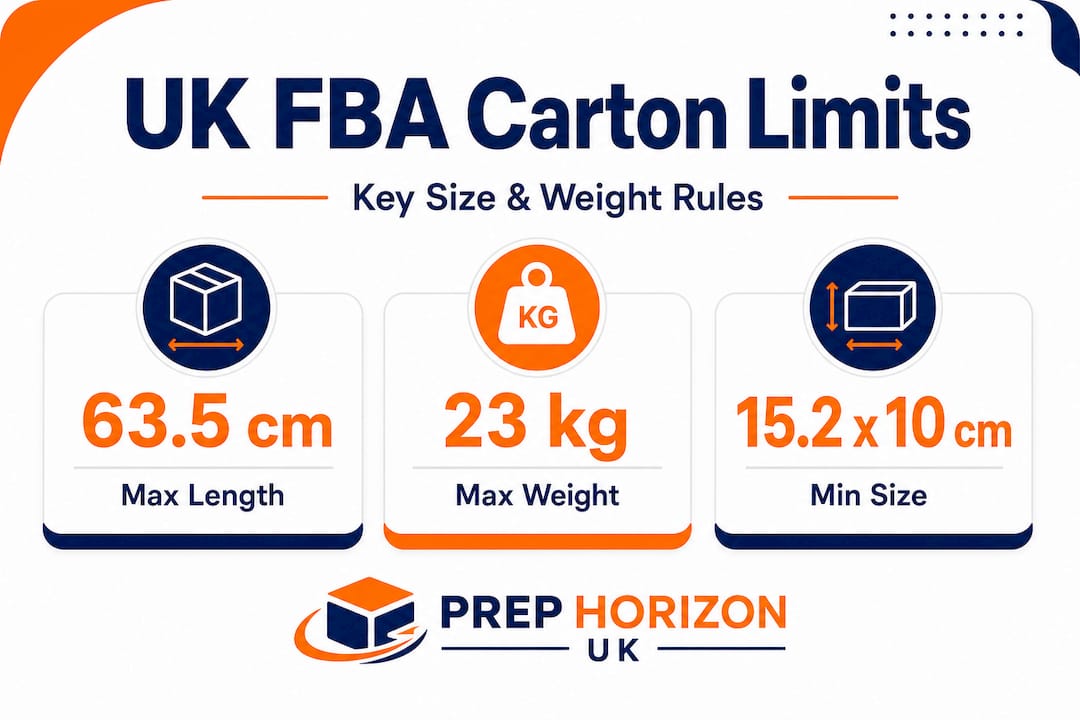
Based on Seller Forum guidance on FBA shipping, the UK carton constraints for general (non-Hazmat) FBA shipments are:
Constraint | Minimum | Maximum |
Box length | 15.2 cm | 63.5 cm |
Box width | 10.0 cm | 63.5 cm |
Box height | 2.5 cm | 63.5 cm |
Box weight | 0.15 kg | 23 kg |
The weight rule deserves attention. Boxes weighing 15 kg or more require specific labelling. The “Team Lift” label must be applied visibly to indicate that two people are needed to handle the carton safely. Heavier packages exceeding Amazon’s limits are rejected outright.
Here is how to audit your cartons before shipping:
Weigh every packed carton on a calibrated scale. Do not estimate based on unit counts.
Measure all three dimensions after sealing, not before. Sealing tape can add height.
Apply the correct weight label (Team Lift or Heavy Package) to any box at or above the 15 kg mark.
Do not overfill. A bulging box may technically measure within limits empty but exceed them once sealed.
Use uniform box sizes where possible. Consistent carton sizes make palletisation and logistics far more predictable.
Key fact: Overloaded or oversized boxes are among the most common reasons for check-in delays at Amazon’s UK fulfilment centres. The error costs are not just time. Refused cartons may need to be returned to a prep centre, re-packed, relabelled, and reshipped, doubling your prep costs for that batch.
Optional: SIPP and advanced packaging routes for FBA UK
For sellers ready to level up efficiency, there are advanced packaging programmes worth considering.
Amazon’s Ships in Product Packaging (SIPP) programme is designed for sellers whose products are already packaged in retail-ready, durable packaging. Rather than being repackaged by Amazon, SIPP-qualified products can ship and be sold in their original packaging. This reduces prep steps, cuts packaging waste, and can improve processing times for high-volume sellers.
However, SIPP is not open to all sellers or products. According to Amazon-packaging.co.uk FAQ guidance on SIPP, the programme includes minimum packaging dimensions of 6 inches by 4 inches by 0.375 inches, and products must pass Amazon’s testing and qualification process before being approved. You cannot simply opt in.
Key facts about SIPP for UK FBA sellers:
Products must undergo physical testing to confirm packaging durability during standard fulfilment centre handling.
Not all product types qualify. Items with complex shapes, irregular packaging, or fragility concerns often do not pass.
SIPP reduces Amazon’s need to add outer packaging, which decreases the overall cost to the fulfilment operation.
Sellers with consistent, steady-selling product lines benefit most. Low-velocity products rarely justify the qualification effort.
SIPP participation does not remove all prep requirements. Barcode compliance and labelling rules still apply.
Pro Tip: If you sell a high-volume product with sturdy retail packaging and you are shipping large volumes each month, it is worth exploring SIPP qualification. Even a modest reduction in prep steps at scale translates into meaningful savings over a full year. Check the latest updates on FBA packaging trends to stay informed on programme changes.
SIPP is best treated as an efficiency option for mature product lines rather than a shortcut for new sellers still learning the compliance basics.
What most sellers (and prep centres) miss about FBA packaging
After understanding the official rules, let’s look at the real-world pitfalls that almost every seller stumbles into as they scale.
The honest truth is that generic checklists do not scale. Early on, a single-page prep checklist might work well enough. You are managing a handful of SKUs and you can keep the details in your head. But as your catalogue grows, as you add textiles alongside electronics, liquids alongside gift sets, that one checklist starts failing you. Items slip through with the wrong bag type. Suffocation warnings get skipped because the person checking assumed the previous batch set the precedent.
The sellers who build reliable FBA operations are the ones who create category-specific standard operating procedures. Not one checklist but a separate, tailored process for each product type they sell. This sounds like extra work upfront, but it eliminates the kind of repeated errors that cost far more to fix than to prevent. You can explore cost-saving ideas for FBA prep to understand how better processes directly reduce operational spend.
The second thing most sellers miss is the cumulative damage of barcode and suffocation warning errors. These are often described as minor compliance issues. They are not. A single batch of units with a mis-covered barcode or missing warning can trigger a full receiving delay. Multiply that across a busy Q4 period and you are looking at serious sales disruption.
We have also seen sellers whose prep centres were simply not asking the right questions. A good prep partner asks about your product category before touching a single unit. They want to know whether items are pre-bagged, where the manufacturer barcodes are, and whether your product type requires any special handling. If your prep partner is applying a one-size-fits-all process to every SKU you send them, that is a warning sign worth acting on.
FBA compliance is not a one-time setup. It is an ongoing operational discipline. The sellers who thrive long-term treat packaging compliance as a core business function, not an afterthought.
How Prep Horizon UK helps you master FBA packaging compliance
Packaging compliance covers a lot of ground. From barcode placement to carton weight, from suffocation warnings to category-specific bagging, every detail has a consequence. Staying on top of it all while running a growing Amazon business is genuinely difficult.

That is exactly why Prep Horizon UK was built the way it is. Our process is designed around the specific requirements Amazon applies in the UK, with category-based checks built into every stage of prep. We carry out proactive barcode audits, verify suffocation warnings on every eligible unit, and validate carton compliance before anything leaves our facility. We do not apply a generic process and hope for the best. We ask the right questions about your product category upfront, so nothing gets missed. If you want full cost clarity before committing, our transparent pricing page gives you everything you need to plan ahead. We make FBA compliance straightforward, so you can focus on growing your business.
Frequently asked questions
What are the Amazon UK FBA box size and weight limits?
Your box must be at least 15.2 x 10.0 x 2.5 cm, no larger than 63.5 cm on any side, and weigh between 0.15 kg and 23 kg. Boxes at or above 15 kg also require a Team Lift label to indicate safe handling requirements.
When are suffocation warnings needed on FBA polybags?
Suffocation warnings are legally required if the bag’s opening is 5 inches or more, measured flat. The warning must be visible, legible, and appropriately sized for the bag.
What happens if my shipment has extra visible barcodes?
If boxes or units have additional visible barcodes, Amazon may mis-scan items, causing delays or errors at the fulfilment centre. Always cover external barcodes on shipping boxes before sending your shipment.
Can all products participate in the SIPP packaging programme?
No, only certain products and sellers can qualify for SIPP. Amazon requires packaging to meet strict size and testing requirements for SIPP before any product is approved for the programme.
Recommended
Comments