
How clear communication transforms your FBA prep results

Most UK Amazon sellers spend hours perfecting their product listings, obsessing over keyword rankings, and comparing shipping rates. Yet the single most common cause of rejected shipments, unexpected rework fees, and missed restock deadlines is rarely any of those things. It is a breakdown in communication. When instructions are vague, responses are slow, or escalation paths do not exist, even the most efficient prep centre will make costly errors. Clear communication streamlines FBA prep by enabling proactive issue resolution, reducing Amazon rejections from labelling errors, and helping UK sellers scale their operations with genuine confidence.
Table of Contents
Key Takeaways
Point | Details |
Define clear protocols | Always establish preferred contact methods, response times, and escalation procedures before starting FBA prep. |
Leverage technology tools | Use real-time tracking and shared online documents to minimise errors and speed up problem resolution. |
Document all interactions | Keep a written record of every important communication to protect yourself if disputes arise. |
Test for responsiveness | Assess a prep centre’s reply speed and clarity with a small request before committing to the partnership. |
Why clear communication is the backbone of efficient FBA prep
Think about the last time something went wrong with a shipment. Whether it was the wrong FNSKU label, a missed poly-bag requirement, or a bundle that arrived at Amazon’s fulfilment centre with items in the wrong configuration, there is almost always a communication gap somewhere in the chain. Someone assumed. Nobody confirmed. A message was left unread.
Poor communication leads directly to rejected shipments. Amazon’s receiving teams have zero tolerance for non-compliant prep, and the cost of getting it wrong includes removal orders, reshipment fees, and potential account suspensions. These are not minor inconveniences. For a seller running tight margins on a fast-moving product, a single rejected pallet can wipe out a month’s profit.
“Top-notch communication saves sellers hours of back-and-forth and is consistently cited as the factor that separates great prep centres from average ones.” (Complete FBA Prepping Guide 2025)
The immediate benefits of strong communication are tangible. Faster processing happens because your prep centre is not waiting on missing information. Errors get fixed before they become shipment-level problems. And you gain genuine peace of mind because you know exactly where your stock is and what is being done to it.
The costs of unclear communication stack up quickly:
Rework fees when prep must be redone due to misunderstood instructions
Amazon rejection penalties from non-compliant labelling or packaging
Wasted inventory from items damaged during unnecessary reprocessing
Delayed restocks that cause you to go out of stock and lose ranking
Strained relationships with your prep partner, leading to deprioritised service
Pro Tip: Before sending your first shipment to any prep centre, ask three simple questions: How do you handle errors? What is your response time commitment? Who do I contact if something goes wrong? The answers will tell you almost everything you need to know about how they communicate under pressure.
For more practical guidance, take a look at these UK seller communication tips that apply directly to common scenarios.
Key protocols for clear seller-prep centre collaboration
Knowing that communication matters is one thing. Having a structured protocol that both you and your prep centre follow consistently is another. Without defined frameworks, even well-intentioned partners default to ad hoc conversations, missed emails, and reactive problem-solving.
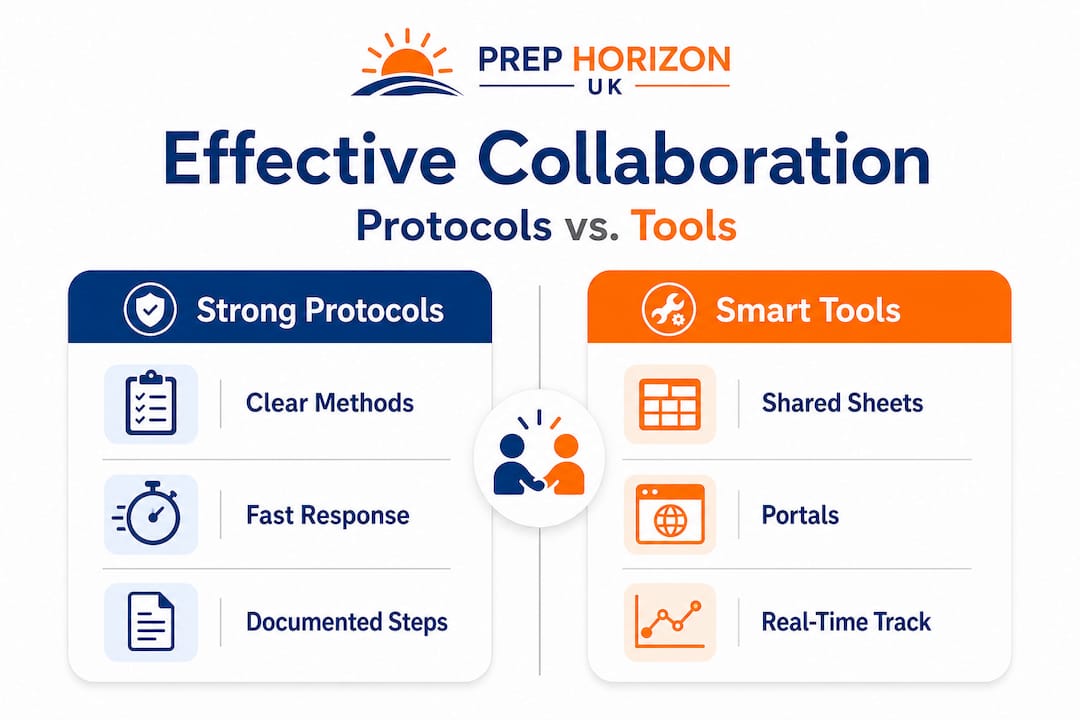
Effective communication protocols involve defining contact methods, agreeing response times of around 24 hours, establishing escalation procedures, and scheduling regular check-ins to prevent breakdowns before they occur.

Here is how great communication protocols compare to average ones:
Element | Strong protocol | Weak protocol |
Contact method | Dedicated email or portal with ticket numbers | WhatsApp or informal texts |
Response time | Committed 24-hour SLA | “We reply when we can” |
Escalation path | Named escalation contact with clear steps | No formal route, rely on goodwill |
Documentation | Written confirmation of all instructions | Verbal agreements only |
Check-ins | Scheduled weekly or per-shipment updates | Only when problems arise |
The difference between these two columns is the difference between a seller who scales confidently and one who is constantly firefighting.
Here is a practical numbered framework to implement straightaway:
Define your contact methods. Agree whether communication happens via email, a shared portal, or a project management tool. Avoid relying solely on messaging apps where important details get buried.
Agree on response times. A 24 to 48 hour commitment should be standard. Anything longer than that during active prep periods is unacceptable. Get this in writing.
Schedule regular check-ins. Even a brief weekly update email prevents small misunderstandings from becoming expensive problems. For high-volume sellers, per-shipment check-ins are worth the time.
Define what triggers an escalation. Not every query needs to reach senior staff. But damaged stock, labelling discrepancies, and anything that could cause Amazon non-compliance absolutely should. Know the escalation route before you need it.
Shared spreadsheets work well for straightforward operations. Dedicated portals add structure and accountability for higher volumes. The key is consistency across all communication channels, not the tools themselves.
Concerning testing responsiveness before partnering: send a small initial task and observe how quickly and clearly your prep centre responds. Poor initial responsiveness is a reliable predictor of future issues.
Pro Tip: Treat your first interaction with a new prep centre as an audition. Send a query with a specific detail and see how accurately they replay it back. A prep partner who listens carefully is worth far more than one who simply promises fast turnaround.
Strong documentation habits are the foundation. Review these FBA documentation best practices to build a solid system from day one.
Role of technology in proactive issue resolution
Technology does not replace good communication. It amplifies it. The right tools give both you and your prep centre shared visibility, reduce the chance of steps being missed, and create a digital audit trail that protects everyone involved.
Real-time tracking reduces errors, and the industry benchmark of a 24 to 48 hour turnaround is only achievable when technology is actively supporting the workflow rather than creating additional friction.
Here is how common tools compare across key features:
Feature | Prep centre portal | Shared spreadsheet | Email threads |
Real-time tracking | Yes | Partial | No |
Automated alerts | Yes | No | No |
Documentation storage | Centralised | Manual | Fragmented |
Seller Central integration | Sometimes | No | No |
Audit trail | Full | Limited | Partial |
The advantages of digital tools extend well beyond convenience:
Automated alerts flag when a shipment reaches a new stage, removing the need to chase updates manually
Centralised documentation means your prep specifications, FNSKU lists, and special instructions are always accessible and version-controlled
Digital check-ins create timestamps that prove when instructions were sent and received, which is invaluable in a dispute
Shared visibility reduces the risk of your prep centre working from outdated information
An important nuance around Seller Central access: some prep centres offer dedicated portals that do not require access to your Seller Central account, which is the preferred approach for security. Others use shared spreadsheets as a practical middle ground. Amazon is explicit that sellers remain responsible for shipment compliance regardless of which prep service they use, so never assume your prep centre’s technology removes that accountability.
Good systems support managing FBA inventory more efficiently, and if you are just getting started, this FBA prep guide for new sellers covers the technology basics you will need.
Best practices for consistent, transparent communication
Systems and tools only deliver value if the people using them maintain good habits. The sellers who consistently avoid shipment problems and costly delays share a set of communication behaviours that are straightforward to replicate.
Using SOPs, documenting everything, and focusing on solutions rather than blame are the three pillars of communication excellence in FBA prep. They apply whether you are working with a large prep centre or a small specialist operation.
Here are the daily habits that make the biggest difference:
Write standard operating procedures (SOPs) for every product type you send. Include packaging specs, labelling instructions, bundling rules, and any Amazon category-specific requirements.
Document every change in writing, even minor ones. If you verbally agree to switch from single-unit to multi-pack prep, follow it up with an email. This is not about distrust. It is about ensuring nothing gets lost.
Use solution-focused language when errors occur. Asking “how do we fix this and prevent it happening again?” is more productive than assigning blame and creates a more cooperative relationship.
Request regular feedback from your prep centre about how your instructions could be clearer. The best prep relationships are genuinely collaborative.
Keep a record of all communications related to each shipment. If Amazon queries a non-compliance issue months later, clear records prove exactly what was instructed and when.
Here is a simple communication template you can adapt for queries and escalations:
Subject: Shipment [reference number] – [brief issue description]
Hi [Name], I am writing regarding shipment [reference]. The issue is [describe clearly]. The impact if unresolved is [explain]. My preferred resolution is [state what you need]. Please confirm receipt and expected response time. Many thanks.
This format works because it is specific, professional, and solution-orientated. It also gives your prep centre everything they need to act quickly without a back-and-forth.
Pro Tip: Always clarify instructions in writing, even when you have spoken on the phone. A simple follow-up email saying “just confirming what we discussed” creates a record and gives your prep centre the chance to flag any misunderstanding before it becomes a problem.
Reviewing your FBA prep requirements regularly ensures your SOPs stay current with Amazon’s evolving standards.
Why communication is your ultimate FBA performance lever
Here is an uncomfortable truth that most guides on FBA prep avoid: sellers who invest in logistics automation, fast shipping, and competitive pricing but neglect communication will consistently underperform sellers who get communication right first.
This is not a theoretical observation. Testimonials about top-notch communication saving hours of avoidable back-and-forth appear consistently in feedback about the best prep centres. The sellers leaving those reviews are not praising speed or price. They are praising clarity.
We have seen it repeatedly: a seller with a well-automated prep workflow hits a snag because their prep centre could not reach them quickly enough to flag a labelling discrepancy. By the time the issue was resolved, a deadline was missed, stock arrived late at the fulfilment centre, and a promotional window was lost. No automation prevents that. Only communication does.
The sellers who scale most successfully treat their prep centre as a genuine operational partner, not a commodity service. They invest time upfront in building communication frameworks, they share their business calendars so their prep centre can anticipate busy periods, and they treat every error as a systems improvement opportunity. When something goes wrong, and it will, those sellers recover faster because the communication infrastructure is already in place.
Communication is also directly tied to your cost-saving FBA strategies. Fewer errors mean fewer rework fees. Faster issue resolution means fewer storage charges from delayed shipments. Better coordination means fewer returns driven by packaging failures. The financial case for prioritising communication is as strong as any operational efficiency argument.
The conventional wisdom says: find the cheapest prep centre that meets your spec. Our view is different. Find the prep centre that communicates best, and you will spend less overall.
Ready to transform your FBA prep experience?
If this article has highlighted gaps in how you currently communicate with your prep centre, the good news is that the right partner makes all of this feel straightforward rather than stressful.

At Prep Horizon UK, clear communication is built into everything we do. From the moment your stock arrives, you receive updates at every stage. Our team responds within agreed timeframes, flags issues proactively, and documents every instruction so nothing is left to assumption. Whether you are a new seller working through your first shipment or an established brand scaling into new categories, we are a trusted FBA prep centre that treats communication as a core service, not an afterthought. Take a look at our affordable FBA prep pricing and see how a prep partner who values transparency can change your experience entirely.
Frequently asked questions
What is the biggest mistake UK sellers make in FBA prep communication?
Failing to set clear response times and escalation procedures before issues arise causes most costly mistakes, as problems escalate unchecked until they become expensive.
Do prep centres need access to my Amazon Seller Central account to communicate efficiently?
No. Many prep centres use dedicated portals or shared spreadsheets and communicate effectively without requiring your Seller Central login details.
How does documenting communication help with FBA disputes?
Written records allow you to prove exactly what was instructed and when, which is essential if Amazon audits a shipment. As using SOPs and documenting everything demonstrates, this habit protects both sellers and prep centres.
What is the standard response time for FBA prep communication?
A 24 to 48 hour turnaround is considered the industry standard for FBA prep communications, and any commitment longer than that during active shipment periods warrants scrutiny.
Recommended
Comments